
TWO:CHAPTER XXXVIII. FALSE IDEAS OF UTILITY.The author of the book was a native of Milan, then part of the Austrian dominions, and under the governorship of Count Firmian, a worthy representative of the liberal despotism of Maria Theresa and her chief minister, Kaunitz. Under Firmian¡¯s administration a period of beneficial reforms began for Lombardy. Agriculture was encouraged, museums and libraries extended, great works of public utility carried on. Even the Church was shorn of her privileges,[2] and before Firmian had been ten years in Lombardy all traces of ecclesiastical immunity had been destroyed; the jurisdiction of the Church, and her power to hold lands in mortmain were restricted, the right of asylum was abolished, and, above all, the Holy Office of the Inquisition. Let these few facts suffice to indicate the spirit of the immediate political surroundings in the midst of which Beccaria¡¯s work appeared.
THREE: It does not follow, because the laws do not punish intentions, that therefore a crime begun by some action, significative of the will to complete it, is undeserving of punishment, although it deserves less than a crime actually committed. The importance of preventing an attempt at a crime justifies a punishment; but, as there may be an interval between the attempt and the execution, the reservation of a greater punishment for a consummated crime may present a motive for its non-completion. The second question is, whether it is expedient to place a reward on the head of a known criminal, and to make of every citizen an executioner by arming him against the offender. Either the criminal has fled from his country or he is still within it. In the first case the sovereign encourages the commission of a crime and exposes its author to a punishment, being thereby guilty of an injury and of an usurpation of authority in the dominions of another, and authorising other nations to do the same by himself. In the second case the sovereign displays his own weakness, for he who has the power wherewith to defend himself seeks not to purchase it. Moreover, such an edict upsets all ideas of morality and virtue,[195] which are ever ready to vanish from the human mind at the very slightest breath. Now the laws invite to treachery, and anon they punish it; with one hand the legislator tightens the bonds of the family, of kindred, and of friendship, whilst with the other he rewards whosoever violates and despises them; always in self-contradiction, he at one moment invites to confidence the suspicious natures of men, and at another scatters mistrust broadcast among them. Instead of preventing one crime, he causes a hundred. These are the resources of weak nations, whose laws are but the temporary repairs of a ruined building that totters throughout. In proportion as a nation becomes enlightened, good faith and mutual confidence become necessary, and tend ever more to identify themselves with true policy. Tricks, intrigues, dark and indirect paths, are for the most part foreseen, and the general quickness of all men collectively over-reaches and blunts that of single individuals. The very ages of ignorance, in which public morality inclines men to obey the dictates of private morality, serve as instruction and experience for the ages of enlightenment. But laws which reward treachery and stir up clandestine hostility by spreading mutual suspicion among citizens, are opposed to this union of private and public morality, a union which is so necessary, and to the observance of which individuals might owe their happiness, nations their peace, and[196] the universe a somewhat longer period of quiet and repose from the evils which at present pervade it.
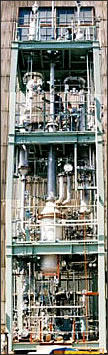
High quality is being demanded in many fields nowadays and so in order to satisfy that we developed a high-purity distillation system in collaboration with Ube industries, Ltd. and Kanto Chemical Co., Inc. The system is used to refine cleaning solutions for the semiconductor industry, medical materials, etc. of high purity (residual ion concentration: 0.01 to 1.0 ppb).
- Our High-purity distillation system provide our clients with high solvent recovery rate, almost 100%.
- The quality of the products/output from our system is very stable, which makes production management very easy, and easier than the conventional ion exchange resin method.
- No emission of waste brings our clients reduction of running cost for environmental measures.
- Our various devices minimize entrainment.
- To prevent the elution of metal, you could ask us the system made of Teflon.
- Our High-purity distillation system has been already proved for solvents that trigger very rapid decomposition reactions, such as hydrogen peroxide.
- Product guide
- Alcohol distillation
- Distillation equipment
- High-purity distillation system
- Membrane separation type solvent dehydration system
- Reactor
- Evaporative concentration equipment
- Coulter spray dryer
- Microwave treatment system
- Filter dryer
- OS filter (continuous vacuum rotating filter)
- Hydrocyclone (liquid cyclone)
- Thermal oil heater (heat medium boiler)
- Process air heater (air heater)
- Ammonia treatment system
- Catalytic deodorizing equipment for ammonia and VOC gas
- Stationary cryogenic storage tank
- Portable cryogenic container
- Cryogenic liquefied gas evaporator